Role-Based Talent Management
A System Linking Organizational and Individual Growth
Nabtesco aims to foster a corporate culture in which each employee takes on challenges and grows together with the company, in pursuit of realizing the Long-Term Vision of becoming “Leaders in Innovation.” The foundation of this culture is role-based talent management.
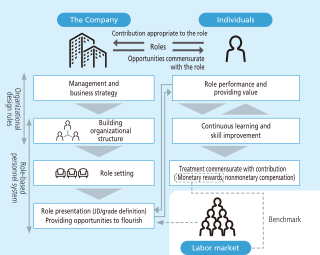
Role-based talent management is a system in which the company defines the necessary organizations and roles based on its business strategies, and employees deliver value aligned with those roles, thereby earning attractive compensation that reflects the market value of their roles and contributions. This system is designed to strengthen the relationship between the company and its employees through “roles (jobs)” while achieving both sustainable enhancement of corporate value and fulfillment of employees’ careers. At the core of this initiative is the human resources system introduced in 2024, which incorporates job-based elements. From 2025, the system has been expanded to cover general employees, and a company-wide role-based human resources system is now in operation.
Position Management – Strategy-Driven Organizational and Position Design
Role-based talent management is a system that links business strategies with human capital strategies to design necessary organizations and positions in a strategy-driven, agile manner, thereby enabling optimal allocation of talent. Organizational design is thoroughly implemented based on common company-wide organizational design rules, with checks and balances applied at either the company-wide or business unit level depending on the organizational hierarchy in order to ensure role-based operations and prevent “competency-based” operations (i.e., structuring the organization around existing personnel).
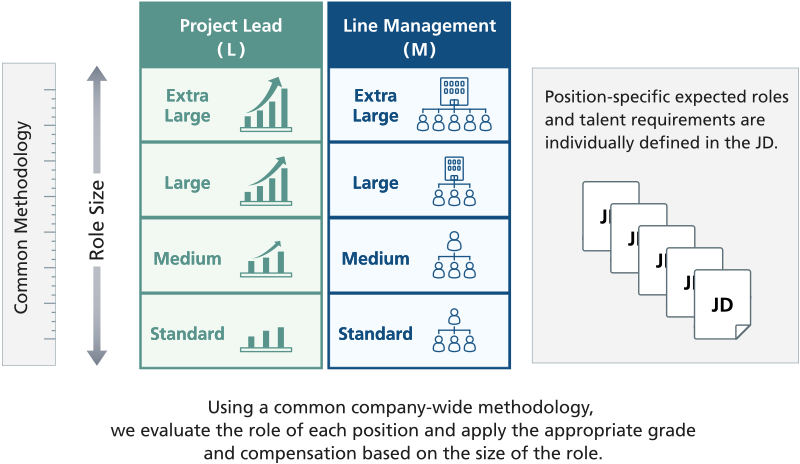
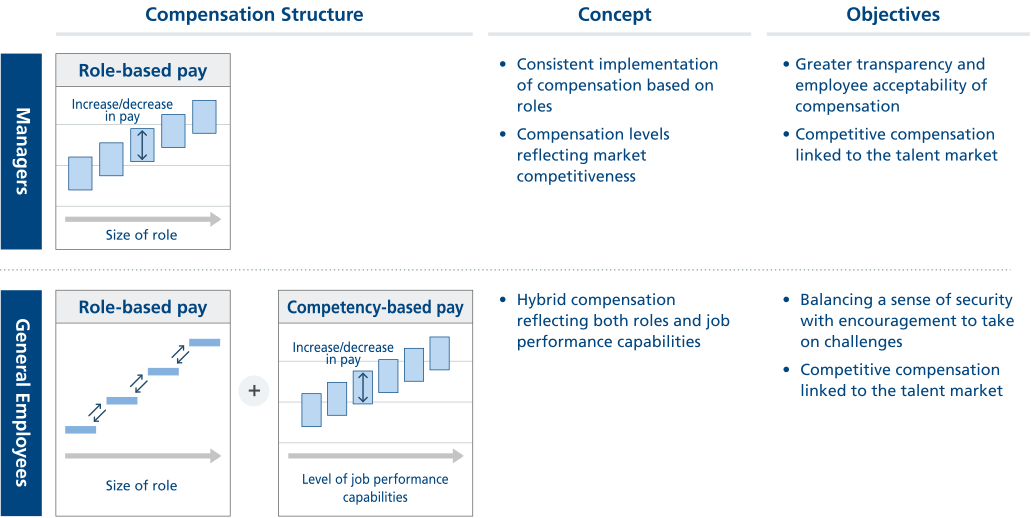
In position design, with respect to managers, the size of each role is measured using a common company-wide methodology, and grade and compensation are determined per position. Even if positions share the same job title, we set different grades and compensation levels depending on the role’s significance for achieving business strategies. For general employees, although not defined at the same level of granularity as for managers, grades and compensation levels are defined according to roles, thereby ensuring a consistent system that is not influenced by attributes such as age or length of service.
Furthermore, managers prepare job descriptions (JDs) that specify the expected roles of each position as well as the skills and experience required for appointment to such positions. This enables position-based talent management, including optimal talent placement and systematic development of personnel for future appointments. In addition, through personnel evaluations, we identify gaps in skills and competencies, and support employees in their autonomous learning and growth, thereby helping them to realize their envisioned career paths.
Overview of Managerial Positions
Performance Management – Cultivating Results and Culture
At Nabtesco, we promote management that balances achieving results with individual growth by clearly defining the roles and expected results of each employee and through fair evaluations, ongoing dialogue, and development.
Role-Based Evaluation System
Under our role-based human resources system, we clearly define the role expected of each employee and have established an evaluation system based on the degree to which each employee fulfills that role, which we operate as an integrated system covering all employees, from managers to general employees.
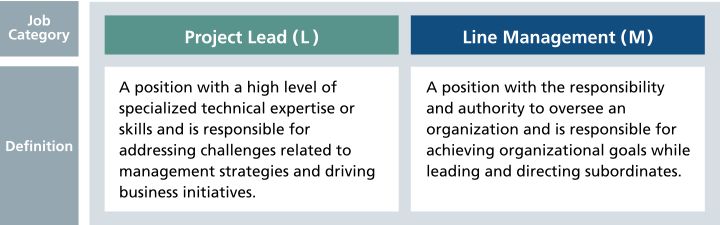
For managers, based on differences in the areas of contribution expected of each position, we have established two job categories: “line management,” which is responsible for leading the organization and achieving goals, and “project lead,” which promotes resolving management issues by leveraging advanced expertise. For each position, we have also developed a Job Description (JD) that clearly defines its roles and scope of responsibilities, together with company-wide role grade definitions. This clarifies the roles expected of each position in executing business strategies, while encouraging incumbents to understand their own roles and proactively commit to fulfilling them.
Evaluation Practices Supporting Goal Achievement and Personal-Growth
In goal setting and evaluation, we thoroughly implement role-based evaluation practices for all managers and general employees.
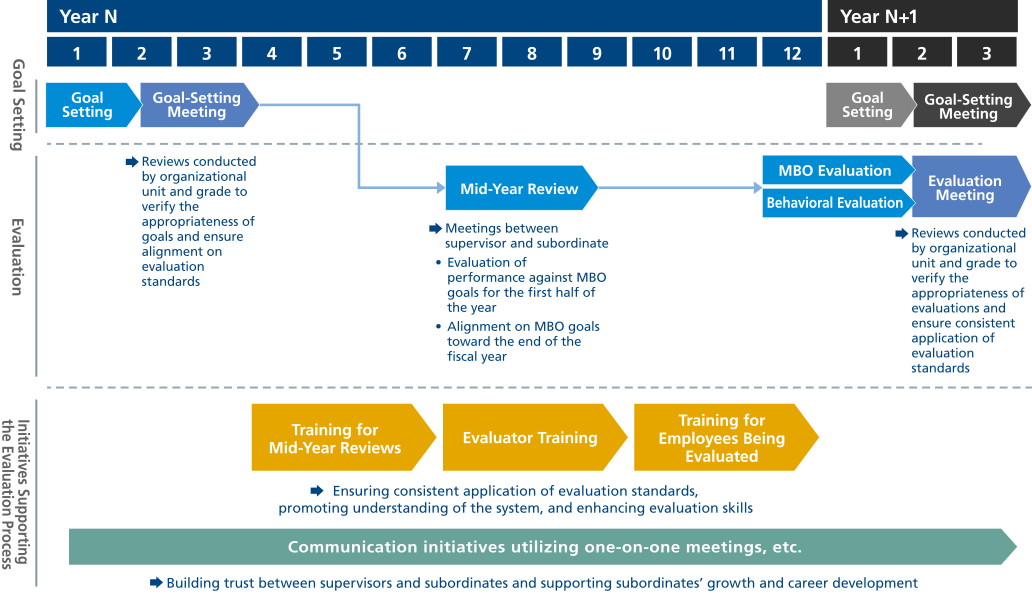
The evaluation system consists of two components: “MBO evaluation (results),” which links organizational goals with individual goals and encourages commitment, and “behavioral evaluation,” which is based on the expected roles for each grade.
Evaluation is not simply for determining individual compensation, but is positioned as an opportunity for employees to correctly understand their roles and link this understanding to growth. Through goal setting, reviews, and evaluations based on Job Descriptions (JDs) and role grade definitions, employees become aware of the expectations associated with their roles, while the organization establishes systems to steadily support employees in fulfilling those roles.
Ensuring Fair Evaluations
To ensure the objectivity and fairness of evaluations, in addition to evaluations conducted by evaluators, we review evaluation results at the company and role-grade levels, among others. This helps reduce variations in evaluations and supports management that generates results across the organization while enhancing fairness and employees’ sense of acceptability.
We also conduct 360-degree evaluations for employees at the general manager level and above, while working to enhance the capabilities of our management team through initiatives such as feedback to encourage self-reflection and training to strengthen development capabilities.
In addition to training for all employees, we continuously provide group training and e-learning for both evaluators and those being evaluated, with the aim of deepening understanding of the role-based evaluation system and establishing appropriate practice.
Team-Based Performance Management
At Nabtesco, we have introduced a team-based performance management system. Based on internal standards, we evaluate the performance of each company on a semiannual basis from both financial and non-financial perspectives. The evaluation results are reflected in individual treatment (bonuses). This enhances a team-based collaborative mindset while enabling a balanced evaluation of individual and team results and promoting organization-wide results creation while ensuring transparency, fairness, and a sense of acceptability.
Performance Support Through Ongoing Dialogue
We believe that building trust between supervisors and subordinates through regular dialogue is important for employees to fully fulfill their roles and contribute to organizational performance.
Accordingly, through “one-on-one meetings,” we promote dialogue not only on work progress but also on career development and individual growth. We also promote communication initiatives such as town hall meetings and engagement programs. By hearing directly from employees and enhancing job satisfaction and collaborative awareness, we foster an environment where employees can more easily fulfill their expected roles, in alignment with the operation of the evaluation system.
In this way, Performance Management is centered on thorough evaluation practices while combining communication and engagement initiatives to create an environment that enables employees to reliably fulfill their roles and supports both the achievement of results and continuous growth.
Overview of the Evaluation Practices
Compensation Management – A System That Rewards Roles and Contributions
In line with the revision of the systems for managers and general employees, Nabtesco has introduced a job- and role-based compensation system. We emphasize providing timely, appropriate rewards based on market value for employees’ roles and contributions, and we strive to provide competitive, attractive compensation. As part of this effort, we participate in external compensation surveys annually, using benchmark data to continuously verify the appropriateness and competitiveness of our compensation levels and, where necessary, to review them accordingly. In addition, when an employee’s role changes due to a personnel transfer, we immediately revise the compensation level to reflect the new role, thereby ensuring a strong link between roles and compensation. At the same time, to ensure that strategic transfers initiated by the company do not lower the motivation of those who already hold positions, we maintain flexibility in operating the system while ensuring fairness.
For non-regular employees, we have established a different compensation system. However, we set compensation levels at appropriate levels based on the principle of equal pay for equal work, with reference to regular employees’ compensation levels (derived from external benchmarks). Moreover, in addition to statutory industry-specific minimum wages, Nabtesco has established its own company-specific minimum wage rules to serve as a safety net.
Composition of Base Compensation
Role-based talent management, through its trinity of “positions,” “compensation,” and “performance,” encourages employees to take on challenges and enables sustainable organizational growth. We aim to further advance role-based talent management, maximize each individual’s potential, and become a company that grows together with society.