Development of Human Resources in the Science and Technology Field
Approach and Policies
Developing Engineering Talent to Realize “Smart Motion Control”
To realize “Smart Motion Control (SMC),” as outlined in Nabtesco’s Medium-Term Management Plan, we need engineering talent capable of creating new value and technologies through flexible thinking that is not bound by conventional approaches. Developing such talent is also a means of realizing the “unique motion control technology” referenced in our Corporate Philosophy: “The Nabtesco Group, with our unique motion control technology, will provide safety, comfort and a sense of security in daily lives as well as any form of transportation.”
While safety remains our top priority due to the nature of our products and services, we believe that by further enhancing our high level of technical capabilities and leveraging synergies with our strong quality capabilities, including in manufacturing, we can provide society with the added value of “safety, comfort and a sense of security.”
Furthermore, as global competition in technological development intensifies among domestic and international companies, it is becoming increasingly important to cultivate talent capable of creating innovation to expand the scope of value creation by solving technical challenges and developing new applications.
To provide products and services that are useful to and trusted by society, we have defined the “ideal profile for our technical professionals” as follows. We cultivate engineering professionals by implementing various training programs and initiatives designed to equip employees with highly specialized skills and a strong mindset that enables them to identify challenges on their own and lead them toward resolution.
- Possess a high level of expertise in a specialized technical area and apply this expertise as a leading expert in their work.
- Possess not only knowledge in one’s own specialty but also knowledge in other fields, as well as a broad understanding of manufacturing.
- Have acquired the ways of working required for problem-solving (such as awareness of cost, safety, and delivery deadlines, as well as problem-solving methodologies) and be able to take concrete action based on them.
- Possess the ability to link engineering skills to concrete business results (such as conceptualization, execution, and interpersonal skills) and can utilize these skills to drive business operations forward.
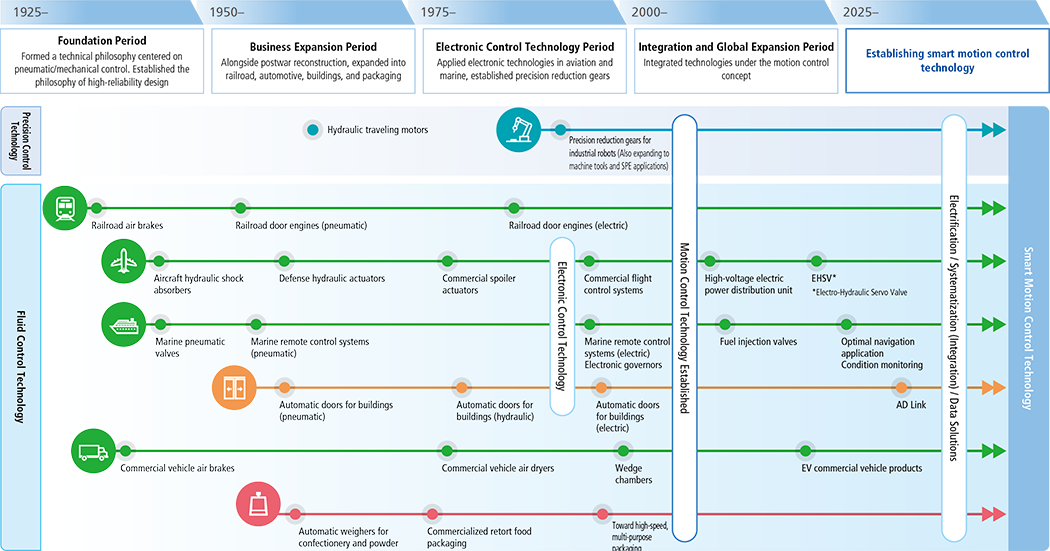
Nabtesco’s Technological Heritage (Excerpt from the Integrated Report)
Measures
Visualizing Required Technologies and Skills
To realize “Smart Motion Control,” which involves advanced control and an understanding of the behavior of the entire system, requires not only knowledge and skills in the mechanical field used to design conventional mechanical products, but also design technologies and skills for electronic components (see “Electrification” below), knowledge of software development and the processes used to develop such software, as well as the technologies and skills of systems engineering (see “Integration” below) to take a bird’s-eye view of the entire system and finalize specifications, and the technologies and skills to analyze data and enhance product value (see “Data Solution” below). With regard to this broad range of knowledge and skills, it is crucial to clarify the specific knowledge and skills required based on each individual’s role, thereby encouraging employees to develop their capabilities autonomously. At the organizational level, it is also essential to promote talent development through work assignments and capability development based on business and development strategies. Furthermore, rather than expecting individuals to possess all the necessary knowledge and skills, it is vital to “visualize” the knowledge and skills that the organization as a whole should possess.
The Relationship Between SMC and Each Technical Domain
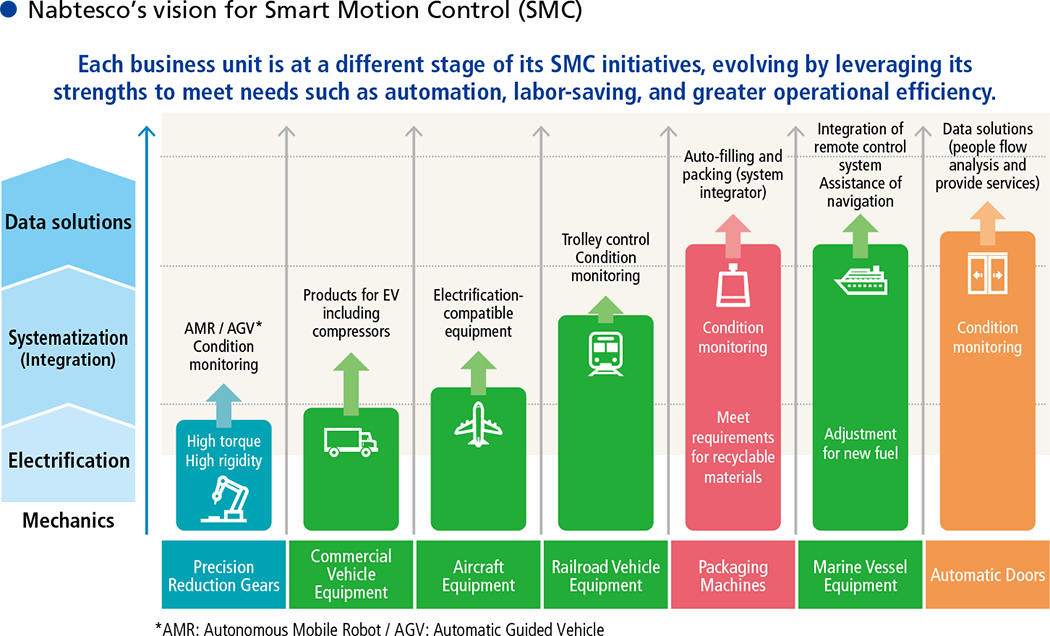
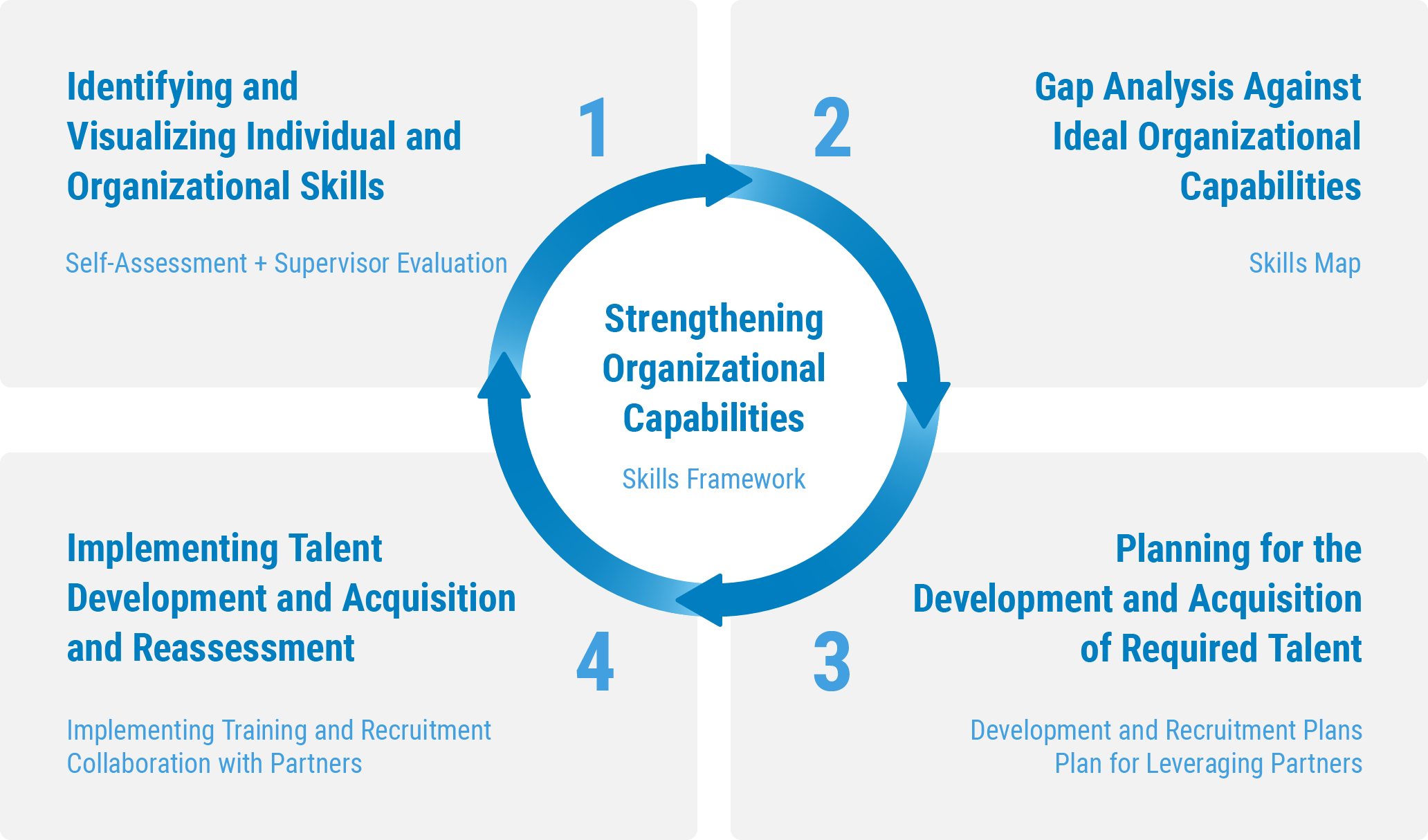
“Visualizing skills” involves both understanding the “current state” of the organization and its individuals and defining the “ideal state” for each. Furthermore, by highlighting this gap, it provides a foundation for implementing various measures—such as strategic work assignments and capability development—aimed at fostering individual growth and achieving the desired organizational capabilities. To fulfill these objectives, we are creating a company-wide, standardized skills framework that can be utilized in future Smart Motion Control product development.
The Cycle of Skill Visualization and Organizational Strengthening
Training and Development Plans Aligned with Career Paths
To bridge the gap between the “ideal state” and the “current state” identified through “skill visualization,” it is necessary to translate the individual skills required based on organizational needs into specific development goals for each individual. In doing so, we develop training and development plans that each individual can agree with and that take a long-term perspective through repeated discussions with supervisors. This approach enables employees to experience self-growth and a sense of achievement, thereby laying the foundation for an organization capable of consistently delivering results.
Engineering Talent Development
·Mechanics Domain
In the Mechanics domain—a traditional strength of Nabtesco—each in-house company independently provides training in the technologies and skills required for its respective business domain. As shared technologies across the Group, we have developed and promoted advanced CAE analysis technologies, including analysis spanning multiple physical domains and digital twins that enable highly accurate and high-speed evaluation. These technologies contribute to improving the quality and efficiency of the design and development process. The technologies and know-how we have established are deployed across each in-house company through training programs, and more than 100 engineers have acquired the skills to proactively apply these analysis technologies in their design and development work.
·Hardware (Electrification)
The transition from conventional hydraulic and pneumatic actuators to electrification requires the acquisition of power electronics and motor design technologies.
While continuing to develop the core technologies required for electrification, we utilize the resulting design documents and simulation models as design guidelines. This promotes the acquisition of the common foundational skills required of the Group’s electrification engineers and cultivates engineers capable of making design decisions that achieve performance, reliability, and safety.
·Software (Integration) Domain
To address the company-wide shortage of software engineers and limited development resources, the Technology and R&D Division established a dedicated software department. This department leads talent development as well as research and development of advanced technologies in the field of software development. By consolidating software engineers from each in-house company through departmental transfers, we are able to train software engineers effectively and efficiently.
·Engineering DX
In system product development, engineers are required to possess the ability to take a broad view across multiple technical domains, understand requirements at the system level, and break them down and deploy them into individual technical domains. These technologies and skills are expected to become increasingly in demand in the future from the perspectives of compliance with functional safety standards and quality assurance. To prevent rework and defects in downstream processes while advancing development comprehensively and efficiently, Nabtesco positions Model-Based Development (MBD) as a foundational technology. We define Engineering DX as a technology for realizing process innovation by leveraging advanced CAE analysis, simulation technologies such as digital twins, and AI, and we are developing talent accordingly.
·Quality
[Quality management training for young engineers]
Since 2007, we have continuously conducted an in-house quality management training program designed to cultivate engineers with a strong awareness of quality. From a medium- to long-term talent development perspective, the program primarily targets young and mid-career design engineers who will lead the next generation.
[Specialized training on product liability (PL) and product safety (PS)]
To realize “safety, comfort and a sense of security” not only for customers who purchase our products but also for everyone who uses them, we have continuously conducted cross-group training sessions since 2007. These sessions are designed to ensure that every employee involved in design, manufacturing, sales, and service recognizes their responsibilities regarding our products and acts accordingly.
·Intellectual Property
[Introductory training in idea generation]
To enhance corporate value through the Nabtesco Group’s sustainable growth, we are promoting an intellectual property management strategy that secures a competitive advantage through our current and future core assets (intellectual property and intangible assets), which serve as the sources of our business competitiveness.
The most important activity within this intellectual property management strategy is creating core value by anticipating market trends and customer needs, as well as acquiring strategic intellectual property rights.
To accelerate our ability to create core value, we have continuously offered introductory training in idea generation utilizing TRIZ (a methodology for inventive problem solving) since 2010. In this training, participants learn methods for generating new ideas for both new and existing products and services through workshop-style sessions based on real case studies. By applying the efficient creative methods acquired through this training, we are committed to developing idea-generation leaders capable of creating new businesses, products, and services.
Specialized Engineering Training
To address the gap analysis based on the visualization of the skills described above, as well as long-term training plans and talent development policies in each department, the Technology and R&D Division plans training programs for each technical field and rolls them out to the in-house companies as needed.
Technical Domains and Corresponding Training Programs (Example)
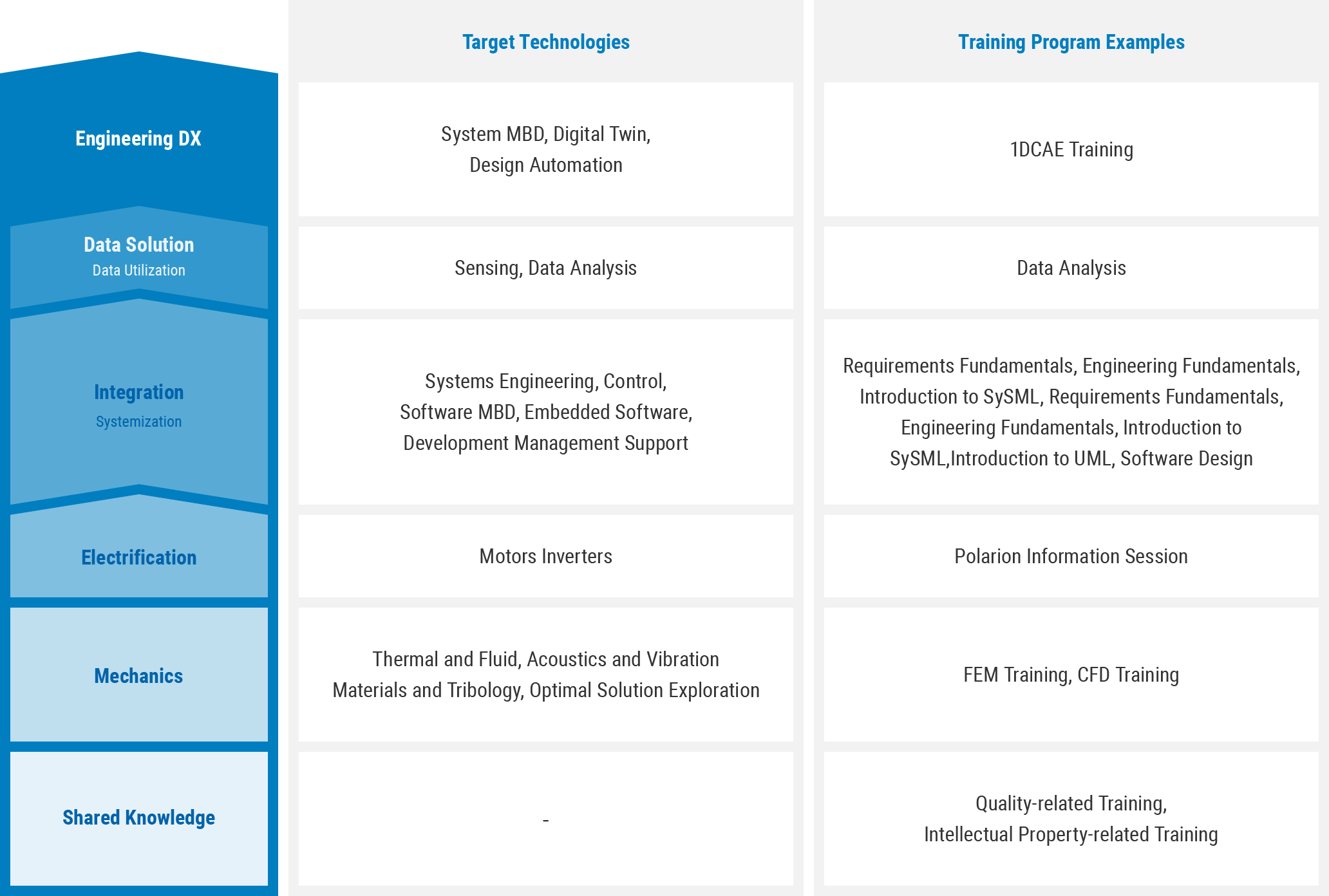
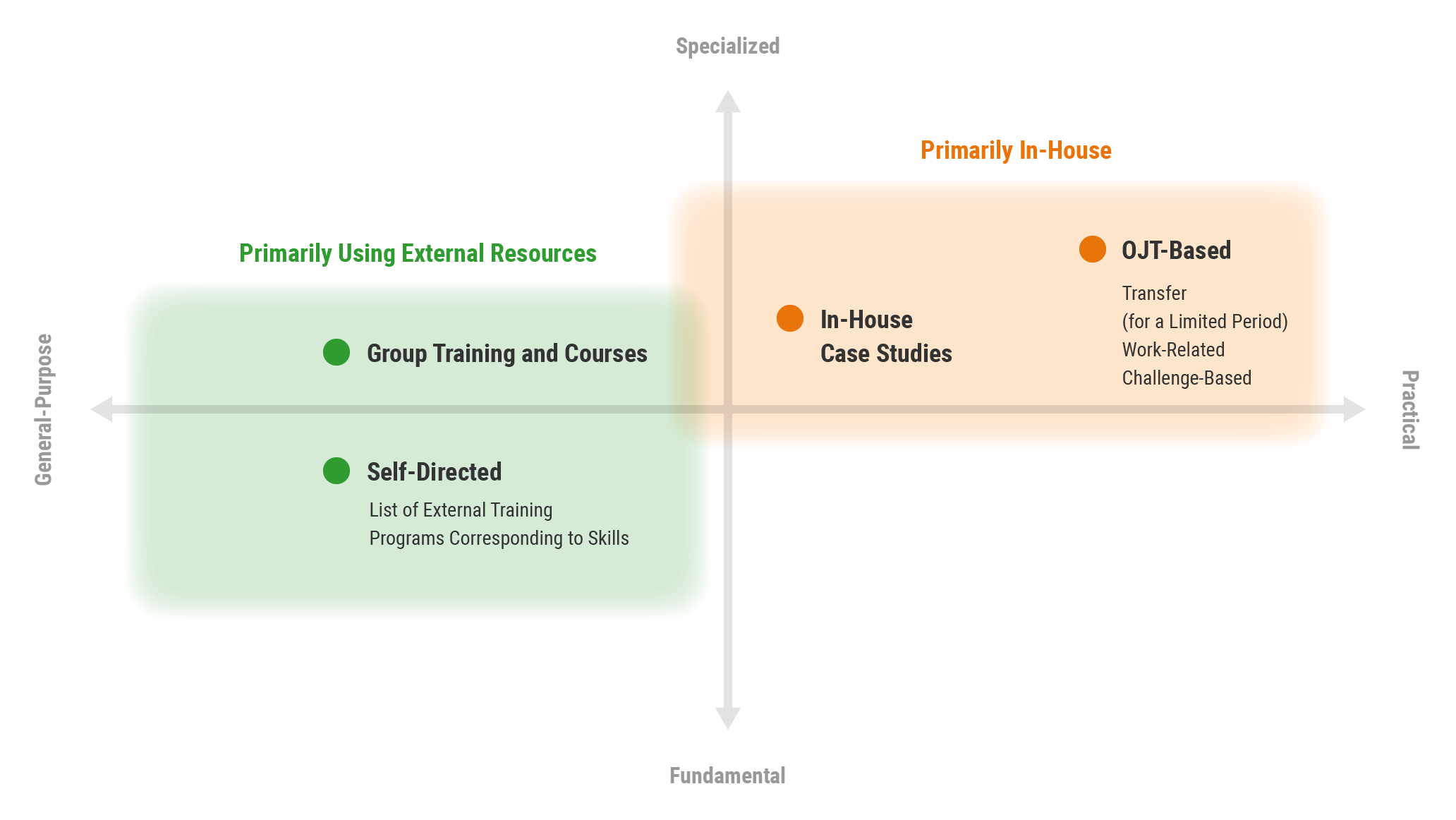
When implementing training, we encourage the use of external resources for basic and general-purpose skill domains where there is already a wealth of external content available. However, for training that uses internal case studies or applies development technologies, where there is a particularly strong emphasis on transferring know-how, we conduct the training internally (in-house), thereby providing training programs using a differentiated approach.
Training Classification Map