

Risk factors
Principal risks
March 25, 2026
Principal risks relevant to the business and accounting status of the Group described in the Annual Securities Report and deemed significant are as follows. If such risks materialize, they may affect our group's performance and financial position.
Note that the risks regarding future contents included in the matters described below were based on the judgment of the Company as of the end of the current consolidated fiscal year.
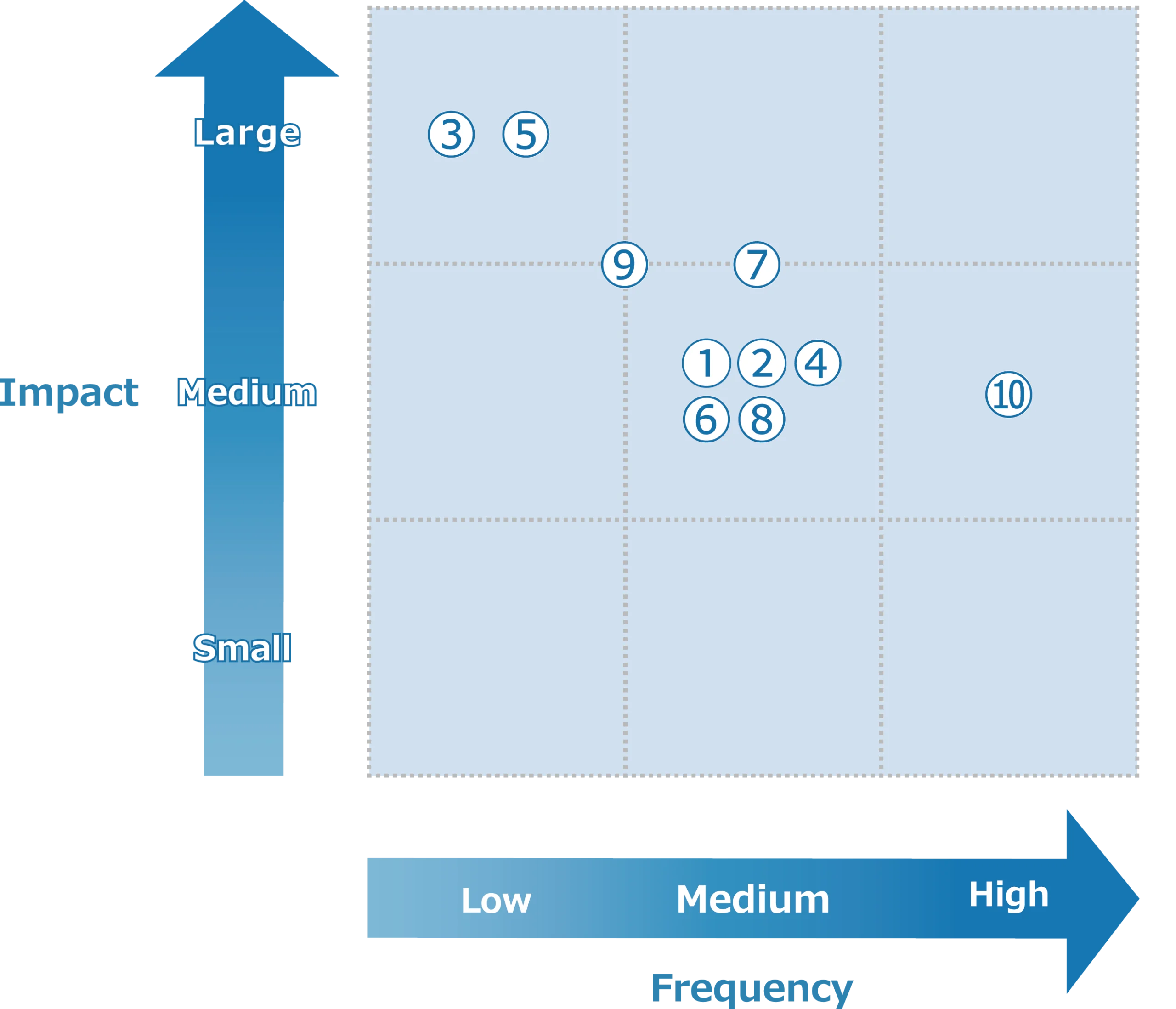
| Major risks on the Group | Frequency | Impact |
|---|---|---|
| ① Risks relevant to the economy, markets and currency | Medium | Medium |
| ② Risk relevant to geopolitical factors | Medium | Medium |
| ③ Risks relevant to large-scale disasters and climate change | Low | Large |
| ④ Risks relevant to procurement | Medium | Medium |
| ⑤ Risks relevant to product quality | Low | Large |
| ⑥ Risks relevant to competition | Medium | Medium |
| ⑦ Risks relevant to information security | Medium | Medium to Large |
| ⑧ Risks relevant to intellectual property | Medium | Medium |
| ⑨ Risks relevant to company acquisitions | Low to Medium | Medium to Large |
| ⑩ Risks relevant to recruiting human resources | High | Medium |
Risk Map
① Risks relevant to the economy, markets and currency
The Group's businesses are directly or indirectly related to a number of industries, including automobile, construction machinery, railroad, industrial machinery and so on, in Japan and overseas. Market fluctuations and trends in capital expenditure in these industries, fluctuations on currency may affect the operating results and financial position of the Group.
| Frequency | Medium | Impact | Medium |
|---|---|---|---|
| Countermeasure | The Group mitigates risks associated with economic fluctuations by operating businesses across a wide range of industries that are subject to different economic cycles. In addition, the Group seeks to minimize the impact of economic fluctuations on its financial performance by expanding its MRO (Maintenance, Repair and Overhaul) business, which is less susceptible to economic cycles. |
||
② Risks relevant to geopolitical factors
In pursuit of further growth and profitability, the Group actively conducts business mainly in Asia, North America and Europe. Therefore, the Group is subject not only to economic and market risks but also to political turmoil and unforeseeable amendments to laws and regulations in various countries, which may affect the markets for particular products. Such events are likely to impact operating results of the Group.
| Frequency | Medium | Impact | Medium |
|---|---|---|---|
| Countermeasure |
The Group regularly monitors political and social conditions, public security, and other relevant factors at and around the locations of its business sites, and strives to implement appropriate measures as necessary. |
||
③ Risks relevant to large-scale disasters and climate change
The Group operates business sites around the world, including factories in Japan and overseas. In recent years, risks associated with various disasters—such as wind and flood damage stemming from global climate change, large-scale earthquakes, pandemics, and other factors leading to social disruption—have been increasing. As a result, the Group’s business performance and financial condition may be adversely affected by personal and property damage, delays in the procurement of materials, and disruptions to logistics networks. In addition, there is no assurance that losses arising from such events will be sufficiently covered by insurance or other measures.
| Frequency | Low | Impact | Large |
|---|---|---|---|
| Countermeasure |
Within the Group, the ESH Committee, which serves as a CEO-direct reporting body responsible for promoting ESH management, collects important information related to the environment, safety, disaster prevention, and health, including risks and opportunities associated with climate change. The Committee deliberates on the assessment of materiality and on measures to address matters assessed as material. |
||
④ Risks relevant to procurement
The Group procurement mainly metal parts and electronic and electrical components from approximately 1,600 suppliers of various sizes. If the supply of parts is disrupted and alternative suppliers cannot be secured due to external factors such as natural disasters or cyberattacks that suspend procurement functions, or due to the bankruptcy of suppliers, the Group’s business performance and financial condition may be adversely affected as a result of deteriorating product margins and the occurrence of opportunity losses.
| Frequency | Medium | Impact | Medium |
|---|---|---|---|
| Countermeasure |
The Group has established a framework to promote supply chain BCP (Business Continuity Planning) activities to address large-scale disasters and risks in general, and is working to enhance the resilience of the entire supply chain by encouraging its suppliers to obtain resilience-related certifications. With respect to cyberattacks, the Group regularly assesses the information security levels of its suppliers and continues to provide support for improvement. In addition to these initiatives, the Group maintains regular communication with its suppliers through measures such as questionnaire surveys. |
||
⑤ Risks relevant to product quality
The Group manufactures a full lineup of products in line with carefully designed quality control standards to prevent defects. However, in case of significant product defects leading to a recall or product liability issues occurring, the potentially massive costs arising from litigation, recall and so on could adversely impact the Group's business performance and financial position.
| Frequency | Low | Impact | Large |
|---|---|---|---|
| Countermeasure |
The Group conducts its product development, manufacturing, and sales activities in accordance with ISO 9001, the international standard for quality management systems. In addition, where required, the Group has obtained certifications for industry-specific quality management systems (QMS), such as IATF 16949 and JIS Q 9100, and has established management frameworks tailored to the requirements of each industry. |
||
⑥ Risks relevant to competition
The Group has a wide lineup of products with high market shares in the domestic and overseas markets. If the market share of its products were to fall due to the delays in the development of new products or the development of new products by other companies, the Group's business performance and financial position could be adversely impacted.
| Frequency | Medium | Impact | Medium |
|---|---|---|---|
| Countermeasure |
The Group is engaged in the development of differentiated products with cost competitiveness that accurately captures customer needs. |
||
⑦ Risks relevant to information security
The Group obtains personal information and confidential information of its customers and trading partners through business activities, and holds confidential information of its business and technologies. In the event of a leakage of information, or destruction or falsification of important data, or system halt due to the unexpected levels of cyber-attacks, unauthorized access, or intrusion of computer viruses, etc., this could result in production stoppages and a deterioration of trust, potentially affecting the Group’s business performance and financial condition.
| Frequency | Medium | Impact | Medium to Large |
|---|---|---|---|
| Countermeasure |
In response to the increasing information security risks in recent years, the Group has established an Information Security Committee with the objective of enhancing information security levels across the Group. The Committee formulates basic policies on information security, works to strengthen security measures, and enables prompt responses to serious security incidents. In addition, the Group has established various management regulations to promote organizational and continuous implementation of security measures for information assets, ensures that these regulations are thoroughly communicated to all employees, and conducts regular education and training on the proper management of information assets. |
||
⑧ Risks relevant to intellectual property
The Group seeks to protect its proprietary technologies through the management of intellectual property rights, including patents, as well as the management of confidential information, and appropriately manages intellectual property and other intangible assets related to its proprietary technologies. At the same time, the Group exercises the utmost care to avoid infringing upon the intellectual property rights or other rights of third parties.
However, if third parties were to infringe upon the Group’s intellectual property rights, if confidential information were to be leaked, or if the Group were to be alleged by third parties to have infringed upon their intellectual property rights, such events could adversely affect the Group’s business performance and financial condition.
| Frequency | Medium | Impact | Medium |
|---|---|---|---|
| Countermeasure |
To ensure the sustainable competitive advantage of its intellectual property and intangible assets (core value), which serve as the source of the Group’s business competitiveness, the Group promotes close collaboration between its intellectual property division and business divisions. From the product and service planning and development stages, technologies that can be effectively analyzed are protected through intellectual property rights, while design know-how that is difficult to analyze and manufacturing know-how continuously generated during mass production are protected through rigorous management of confidential information. |
||
⑨ Risks relevant to company acquisitions
The Group seeks to enhance the production system for its products in Japan and overseas, its sales and service systems, and its technology platform through company acquisitions. However, if the effects that were expected at the time of the acquisition cannot be gained in the future, the Group may recognize impairment loss of fixed asset such as goodwill and the Group’s business performance, and financial position may be affected.
| Frequency | Low to Medium | Impact | Medium to Large |
|---|---|---|---|
| Countermeasure | The Group has established Group M&A Guidelines to clarify its acquisition processes. In addition, during the consideration stage of potential acquisitions, the Group conducts due diligence on target companies and reviews the post-acquisition operation and management of such companies. |
||
⑩ Risks relevant to recruiting human resources
The Group seeks to promote global business activities and maintain and improve its competitiveness by recruiting and developing a broad range of human resources with competence in manufacturing, development, sales and other specialized fields. However, failure to recruit and develop a sufficient number of personnel due to intensified competition over human resources and the retirement of employees may lead to a drop in competitiveness, affecting the Group’s business performance and financial position.
| Frequency | High | Impact | Medium |
|---|---|---|---|
| Countermeasure |
To secure a diverse pool of talent, the Group is promoting initiatives such as adopting various recruitment methods, including alumni recruitment¹ and referral recruitment², as well as establishing a professional track system to attract and retain highly specialized professionals.
|
||
